
India's Election Commission's centralised voter database systems, ERONET and ECINet, are under scrutiny following concerns raised by Election Commissioners Sukhbir Singh Sandhu and Vivek Joshi regarding the centralisation of electoral rolls and control available to state election officials. The article explains how these systems work and why they are currently in the news.

The Election Commission of India has announced decisions addressing concerns raised by two election commissioners, Sukhbir Singh Sandhu and Vivek Joshi, over the past 10 months. These issues included changes to voter registration forms, access to the electoral roll database, the handling of Goa's 97 voters, communications issued without full commission approval, oversight of the IT division, and appeals against voter restoration. The EC has provided responses and outlined steps to resolve these internal disputes and improve transparency and compliance.

Election Commissioners Sukhbir Singh Sandhu and Vivek Joshi reportedly flagged multiple issues during the Special Intensive Revision (SIR) of voter rolls, including name deletions. Despite a media report suggesting 14 objections over 10 months, Election Commission officials assert that all decisions, including SIR, were unanimous and approved by all commissioners. The report also highlights opposition parties' criticism of the SIR, alleging it targets non-BJP aligned voters.

A political controversy has erupted over the inclusion of BJP Rajya Sabha MP Raghav Chadha's name in Delhi's electoral rolls. The Aam Aadmi Party (AAP) has alleged procedural irregularities, questioning how his name appeared in the Rajinder Nagar constituency's voter list despite the draft rolls showing fewer entries. Poll officials confirm Chadha's name was added through the updation process after being removed from Punjab's rolls, while Chadha dismisses AAP's claims as a 'bitter ex' reaction.

Trinamool Congress leader Saket Gokhale has accused the Election Commission of India (ECI) of withholding details about the software and algorithm used for the Special Intensive Revision (SIR) of electoral rolls. Citing an RTI response, Gokhale highlighted the ECI's claim that the information relates to "commercial confidence, trade secrets and intellectual property matters," raising concerns about transparency in the electoral process.

President Donald Trump has advocated for stricter electoral laws in the US, praising India's election system and its requirement for photo identification. He highlighted Chief Election Commissioner Gyanesh Kumar's questioning of the lack of voter ID in American polls and used India's high voter turnout with minimal postal ballots as an example. Trump is pushing for the SAVE America Act, which would mandate proof of citizenship and nationwide voter ID, though the bill faces division in Congress.

Abhijeet Dipke has issued a strong call to Indian opposition parties, urging them to boycott elections if they genuinely believe the electoral process is rigged, arguing that their continued participation only legitimises alleged unfairness.

The Election Commission has clarified that its ECINet platform is decentralised, with statutory functions performed only by designated officials, not headquarters staff. This comes after concerns were raised about the centralisation of electoral roll databases. The EC also defended the legality of an additional declaration sought from new voters during the Special Intensive Revision, citing unanimous commission approval and a Supreme Court judgment.

'Election Commissioners are Constitutional authorities and they are not supposed to go to the Cabinet secretary. They are not supposed to write letters. And if they are aggrieved, they should straight go to the President of India.'

Former Chief Election Commissioners have voiced strong objections to reported 'illegal' changes in voter registration Form 6 and the centralisation of electoral roll control, raising serious concerns about the integrity of future elections.

Chief Election Commissioner Gyanesh Kumar is facing significant scrutiny after an investigation revealed objections from his fellow election commissioners, Sukhbir Singh Sandhu and Vivek Joshi, regarding decisions made during the Special Intensive Revision of voter lists. The objections, reportedly made at least 14 times, concerned issues like changes to voter registration forms and centralised control over electoral roll databases, intensifying criticism of Kumar's tenure and the EC's impartiality.

The Delhi poll body has issued notices to several prominent voters, including Chief Minister Rekha Gupta and AAP supremo Arvind Kejriwal, for discrepancies in their enumeration forms during the ongoing Special Intensive Revision (SIR) exercise. While Gupta's entry has been validated, millions of other voters, including other political figures, have received notices for issues like age-related mismatches or being unmapped with previous SIR records, requiring them to submit documents by October 29.
Opposition parties are planning a third attempt to move a motion for the removal of Chief Election Commissioner Gyanesh Kumar in both the Lok Sabha and Rajya Sabha. This renewed effort follows an Indian Express report highlighting objections from two other Election Commissioners regarding decisions made without their knowledge, particularly concerning voter registration and electoral roll management.

Three BJP allies, including LJP (Ram Vilas), TDP, and RLM, have called on the Election Commission for a clearer explanation regarding concerns raised by two Election Commissioners over the voter list revision process. Union Minister Chirag Paswan warned that public faith in elections was at stake, while the EC asserted that differing views among its members were normal and final decisions were unanimous.

A petition has been filed in the Supreme Court challenging Chief Election Commissioner Gyanesh Kumar over alleged statutory duty violations and the controversial deletion of 13 crore voters during the Special Intensive Revision of electoral rolls, claiming decisions were made without the concurrence of other election commissioners.
The Election Commission of India has addressed reports of internal dissent among its commissioners and clarified that all Special Intensive Revision (SIR) orders and Form 6 updates for voter enrolment received unanimous consent and were upheld by the Supreme Court. The EC also announced measures to ease the process for voters issued notices, including doorstep document collection and extended deadlines in Delhi and Maharashtra, while affirming its commitment to transparent decision-making and meticulous compliance with directives.
The Election Commission of India has defended its Special Intensive Revision (SIR) of voters' lists, asserting that differing views among Commissioners are a normal part of deliberations and all orders carry full legal sanction, following reports of two Commissioners red-flagging issues.

Rajya Sabha MP Raghav Chadha has accused the Aam Aadmi Party (AAP) government in Punjab of political vendetta after his name was marked as 'shifted' in the draft electoral rolls despite being registered in Mohali. The AAP has refuted the claims, stating that Chadha has been living in Delhi and was attempting to get his voter registration made in Delhi through a 'backdated process'.

The Election Commission is set to introduce artificial intelligence-based verification systems during the ongoing Special Intensive Revision (SIR) of the electoral rolls in West Bengal to prevent the inclusion of fake or deceased voters, a senior official said on Tuesday.

The Supreme Court has sought responses from the Centre and States regarding a plea alleging the misuse of Aadhaar cards as proof of citizenship, domicile, and residential address. The petition argues that despite legal provisions, Aadhaar is being used for purposes beyond identity verification, potentially aiding illegal immigrants, and calls for a comprehensive overhaul of electoral verification processes.

'The protection of secrecy and anonymity gets lost with this linking.'

The Election Commission released the names of deleted voters in West Bengal ahead of the publication of the draft electoral rolls for the upcoming assembly elections.
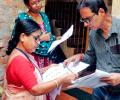
In a unique initiative to speed up the ongoing special intensive revision of electoral rolls, the Pilibhit administration has announced a set of incentives, including a family safari and lunch, for booth-level officers who fills up the maximum number of digitised forms in their respective assembly constituencies.
The Election Commission defended its Special Intensive Revision (SIR) exercise for Bihar's voter list in the Supreme Court, calling it accurate and dismissing allegations of impropriety by political parties and NGOs.
The number of similar electoral photo identity card or EPIC numbers found were "miniscule", averaging to around one in four polling stations, they said.
The Election Commission suspended four officers and a casual worker in West Bengal for alleged dereliction of duty and lapses in preparing electoral rolls. The action follows allegations of electoral roll compromise at the behest of the ruling Trinamool Congress.

Admiral Prakash, who has been settled in Goa since his retirement, said SIR forms should be revised if they are not "evoking" the required information.

The Trinamool Congress (TMC) has accused the Election Commission of India (ECI) of a "scam" after the poll panel admitted to the existence of duplicate voter ID numbers. The ECI has said it will address the issue in the next three months. TMC leader Saket Gokhale alleged that the ECI is trying to "protect" someone and demanded answers about the extent of the duplication and why it took 25 years to address the problem.

Under the new rules, users must take a "live selfie" using software that verifies their presence, typically through eye-blinking or head movement. The measure helps prevent the use of static photos or deepfakes.

Congress leader Rahul Gandhi on Wednesday claimed that a 'systematic vote chori' method, evolved by Prime Minister Narendra Modi and the Election Commission to 'kill Indian democracy', will be deployed in the Bihar assembly polls as well.
The order also highlights further disparities, citing examples of Denmark and Sweden restricting mail-in voting to those unable to vote in person and rejecting late-arriving ballots regardless of postmark, while many US states have embraced widespread mail-in voting, with some accepting ballots without postmarks or those arriving well after Election Day.

Quoting an incorrect PAN during property registration can invite penalties and prosecution.

He lived in the Pittsburgh suburb of Bethel Park, about 56 km south of the Trump rally site where law enforcement officials said he fired at Trump, the presumptive presidential candidate of the Republican Party.

Security agencies have gathered evidence, including Pakistani government documents and biometric data, confirming that the terrorists involved in the Pahalgam attack were Pakistani nationals.

It is voluntary to link Aadhaar with a voter ID and consent is obtained from the elector for Aadhaar authentication in Form 6B which was recently introduced, he said.

The draft National Code Against Age Fraud in Sports (NCAAFS) 2025, which mandates penal action against violators and calls for AI-based bone assessments to accurately determine an athlete's age, is set to become a policy soon with the sports ministry planning to send it for cabinet approval next week.

The Trinamool Congress (TMC) has demanded that the Election Commission (EC) accept its error in issuing duplicate voter card numbers within 24 hours, threatening to release more documents on the issue if the EC fails to do so. The party alleged that the EC issued the statement after the TMC announced it would hold a press conference on the issue, and termed it an "Epic Scam." The EC had said it would rectify the issue and update its technology-driven platform, but the TMC insists the EC must accept the error. The party also demanded an in-depth probe into the matter.

Two persons were arrested in Surat in Gujarat for allegedly forging documents like Aadhaar and PAN cards as well as voter IDs using a website, in the process posing a serious threat to national security, a police official said on Monday.

New software will ensure that anyone with more than one election ID has to surrender the other cards.

If implemented after stakeholder consultations, migrant voters do not need to travel to their home district to exercise their franchise.
